







|
|
|
|
|
|
|
|
|
|
|

|

|
|
State-of-the-Art
Furniture, Starting at $7,000, page 18 By Karen Schwartz Dyad Studio, 718-797-2030 www.dyad.com 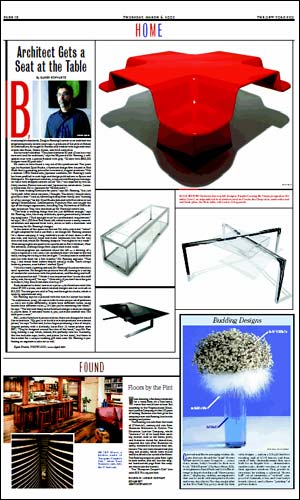 By most people's standards, Douglas Fanning's career as an architect was progressing
nicely several years ago.A graduate of Columbia's School of Architecture, he
taught at Parsons and worked with high-end retail clients like Gucci, Donna
Karan, and MAC cosmetics.
By most people's standards, Douglas Fanning's career as an architect was progressing
nicely several years ago.A graduate of Columbia's School of Architecture, he
taught at Parsons and worked with high-end retail clients like Gucci, Donna
Karan, and MAC cosmetics.But he wasn't satisfied. "The years between 30 and 40 can be a real no-man's land for architects," says the 35-year-old Mr. Fanning, a softspoken man with a goatee flecked with gray. "Clients with $500,000 budgets want 50-year-olds." He seems to have found a way out of this predicament. Two years ago, he founded Dyad Studio, a furniture design firm housed in Red Hook that is garnering praise for its minimal, elegant creations. With a distinct 1960s Mod-meets-Japanese aesthetic, Mr. Fanning's work has been profiled in such high-end design publications as Space and Metropolis. His signature creation, a race-car-red fiberglass rectangular table with dropped corners called "Ori," was inspired by two unlikely sources: Ferrari race cars and Japanese tea ceremonies. (Loosely translated, Ori is Japanese for "folded cloth.") "I'd been making furniture for years," says Mr. Fanning, "but just for myself. After about six years, I thought, 'You know, I should really give this a shot.'" And so, borrowing money from family and "burning all of my savings," he did. Dyad Studio debuted with five tables at last spring's International Contemporary Furniture Fair, and caught the eye of the design cognoscenti, including Troy Halterman of SoHo design emporium Troy, who snatched up Mr. Fanning's entire line. "The trick is creating things that are just different enough," says Mr. Fanning, who, like many architects, sports geometrically interesting eyeglasses. ("Bad eyesight must be a professional requirement," he says.) His 1,000-foot Red Hook loft, which boasts a newly renovated kitchen and exposed brick walls, serves as both a showroom and laboratory for Mr. Fanning's designs. In the center of the space are the red Ori table and metal "tubes" of light adapted for home use from a set design Mr. Fanning created for a dance company. A long worktable made of steel doors is off to one side, and built-in wood and metal bookcases line the far wall above the bed, which Mr. Fanning sleeps in "two nights or so a week." (Remaining nights are spent in his apartment in Hell's Kitchen). Near the entrance, clothing hangs from unpolished metal racks. Works-in-progress are scattered about the loft, a drawing of a table is taped on a wall and a low cardboard chair sits next to the red table, waiting for its day in the limelight." I make pieces in cardboard and live with them for a few months," Mr. Fanning explains. "That way, I can tweak them before they're actually made. That's always been my process, even before I started Dyad." While his work is getting noticed, Mr. Fanning's business remains a small operation. He designs the pieces in the loft, turning to a variety of vendors for assistance with the production, and finishing and buffing each piece himself." I think it was important that I made the stuff on my own, for myself," he says." Ultimately, if you don't have the guts to make it, why should someone else buy it? " Such attention to detail comes at a price , his furniture retails for about $7,000 a piece, and commissioned designs can run as much as $12,000.The designs are sold at Troy and through his studio, which is open by appointment only. Mr. Fanning says he is pleased with the turn his career has taken. "In architecture, every job comes with its own unique set of problems , walls are made differently, clients have different tastes, co-op boards have different rules , it's like you're recreating the wheel," he says." The brilliant thing about furniture design is once you design it, you're done. If someone wants it, you just make another one. The hard part is over." Still, as the furniture business evolves, there are changes he would like to institute. "My goal is to be able to make products at moderate prices," he says. To that end, he has begun producing a line of simple, elegant pottery with a distinctly Asian flair. (A water pitcher costs $80.) "They're designed around the idea of the hand," says Mr. Fanning, holding a cup which, indeed, fits perfectly into his. Currently, the line includes cups, bowls, and plates (in two sizes), but those in the market for a unique wedding gift take note: Mr. Fanning is perfecting an ergonomic sake set as well. |
